Revelation of Jesus Christ
Ἀποκάλυψις Ἰησοῦ Χριστοῦ
The Book of Revelation was likely written by the Apostle John during his exile on Patmos near the end of Emperor Domitian’s reign, around A.D. 90 (commonly dated between A.D. 85–95), as affirmed by early church testimony (Irenaeus, Victorinus of Pettau, Eusebius, Jerome). While the exact year is uncertain, historical and textual evidence place its composition near the close of the 1st century. All existing manuscripts of the Book of Revelation are preserved in Greek, including early witnesses such as the Codices Sinaiticus and Alexandrinus. However, the text’s linguistic character is highly Semitic, displaying grammatical constructions, idioms, and patterns of parallelism that reflect a Hebrew or Aramaic texts. These features indicate that John was composing within that context. The book’s vocabulary and imagery draw heavily from the Hebrew Scriptures, giving Revelation a distinctly Jewish prophetic style.
King James Revelation Modernized (KJRM) and KJRM Interlinear, produced by Kevin Dees, updated last 26 July 2026.
Greek manuscript resources: Center for New Testament Restoration, Center for the Study of New Testament Manuscripts, Codex Alexandrinus and Codex Sinaiticus.
A Note to the Reader
While this study attempts to render what Revelation's manuscripts communicate, it is impossible to grasp the depth of this book in English. Revelation is deeply patterned, and English cannot carry those patterns faithfully. Reading in English will cause you to see patterns that simply do not exist, and to miss patterns that do — and either one can completely misguide you. English has no equivalents for many of Revelation's Greek words — such as Revelation 14's word for gathering grapes (Revelation 14:18–19) — so much of Revelation is flattened in English, and at other times English expands the meaning of a word beyond what the original Greek intends.
When Jesus warns that nothing may be added to or taken away from the words of this book (Revelation 22:18–19), that is not only a warning — it is also guidance for how the book must be approached. Anything but the Greek will absolutely leave you missing something. So read Revelation in English — that is fine — but consult the Greek before you come to a conclusion; conclusions must be built on the Greek. This is one of the most important findings I encountered in doing this study, and it is the first one I hope you learn.
The Revelation of Jesus Christ to the Churches: Overcome
The Greek verb σημαίνω carries the sense of “to give a sign,” “to signal,” “to point out,” “to indicate,” “to make clear,” “to make known,” “to communicate information,” “to report,” “to disclose,” or “to signify.” Thus, in Revelation 1:1, ἐσήμανεν may be understood as “He made it known,” “He communicated it,” or “He signified it.” The word can involve communication through signs, but it does not, by itself, require the meaning “to make symbolic.”
Thus, when Revelation 1:1 is translated as “he reported it,” the Greek could also carry the sense that He “made it known,” “communicated it,” or “indicated it,” with the possible nuance of communicating by means of a sign. This does not mean that every detail in Revelation is symbolic, but it does show that the book itself allows for symbolic communication. This is not only suggested in the opening verse; it is explicitly demonstrated when Jesus interprets the seven stars and the seven lampstands for John: “The seven stars are the angels of the seven churches: and the seven candlesticks which thou sawest are the seven churches.” (Revelation 1:20, KJV). Therefore, Revelation should not be forced into a purely literal reading at every point. The lampstands are real features within John’s vision, but they are not merely literal lampstands; they signify the churches, portrayed through the heavenly image of light-bearing stands before Christ.
Re 1:1, Re 22:16 — Bookend — "sent my messenger"
Reading would be out loud
Re 1:3, Re 22:10 — Bookending — "time is at hand."
Message to the Seven Churches: Peace From The Father, Seven Spirits, and Jesus
The throne is the Father's in the immediate logic of Revelation 1:4-5. Grace and peace come from Him who is, and who was, and who is to come; from the seven Spirits before His throne; and from Jesus Christ. The greeting distinguishes the Father, the seven Spirits, and Jesus, even though Revelation will later speak of the throne of God and of the Lamb together.
He is not just King of Kings but also prince or ruler, ἄρχων, of the kings.
“Released” (λύω) appears in the Critical Text, while “washed” (λούω) is found in the Majority Text; in Greek, these two verbs differ by only a single letter. Within Revelation’s broader context, Christ is portrayed as the one who ransoms and redeems, while the saints are primarily described as those whose robes are washed in the blood of the Lamb (7:14; 12:11; 22:14). Revelation also describes the saints by endurance, testimony, commandments, and faithfulness (12:17; 14:12; 20:4), but those works are not presented as the ground of their worthiness. This pattern suggests that, in this instance, the sense of Christ freeing rather than washing is the more contextually fitting reading.
Re 1:5, Re 3:14
Re 1:5, Re 3:14, Colossians 1:18, Colossians 1:15
Re 1:5, Re 20:9
Kingdom of Priests unto God
Important Note: Textual variants cause Revelation 1:6 in some translations, such as the ESV, to read, "He made us into a kingdom, priests to His God and Father." Likewise, Revelation 5:10 reads, "You have made them into a kingdom and priests to our God, and they will reign upon the earth." The evidence strongly suggests that the intended theme is "a kingdom of priests," not KJV's "kings and priests" echoing Exodus 19:6: "And ye shall be unto me a kingdom of priests, and an holy nation."
ἀμήν — "truly" for Amen
Re 1:6, Re 5:13
Re 1:7, Re 10:1, Re 14:14-16, Daniel 7:13 — Jesus coming in the clouds.
Re 1:7, John 19:37, Zechariah 12:10 — This is making it very clear the type of death Jesus died and connecting him to the person who is coming in the clouds.
The KJV/TR adds "the beginning and the ending"; the critical text reads Ἐγώ εἰμι τὸ ἄλφα καὶ τὸ ὦ, λέγει κύριος ὁ θεός — the title continues without the expansion.
Companion in Tribulation
Important Note: John points out that, regarding the church, he is in tribulation, and the saints who will be in tribulation can be patient in Jesus as he is. The letters to the churches were present and future when delivered to the seven churches, and they are past to us only in that original historical setting. Revelation 1:19 frames the writing as “the things which you have seen,” “the things which are,” and “the things which shall be after this,” so the letters can be read as applying to the original churches, to the present church, and to a future church in tribulation.
Tribulation for the church is not unique to what has been labeled as "the great tribulation" of 7 years. All Christians will face tribulation. When we read Revelation and John speaks of being a "companion in tribulation," he is referring to that shared trouble we have in this world. But there is also a tribulation that is great, taking place over 7 years, and many will enter into it. So when we see reference to the "patience of the saints," we should not confuse the tribulation we face every day as the church with what is meant to be a very particular tribulation at a very particular time. This is why many use the special label "the great tribulation" to make that distinction clear. Even so, this study treats "great tribulation" as a descriptor, not a title — Matthew describes the peak, while Revelation 7:14's double-article Greek designates the span itself: "the tribulation, the great one" (see 7:14). There are types and degrees of tribulation (2:22; 7:14; Matthew 24:21), and the seven years escalate from great at the opening to an all-time peak at the middle, the same way the earthquakes escalate across the seals, trumpets, and vials (8:5; 11:19; 16:18). Context, not the term alone, assigns each passage its place on that path. Here John is making a soft relation in the shared theme of waiting on Jesus (6:9; 12:17; 13:10; 14:12).
John says he is a “fellow partaker,” which appears to echo the language found in Paul’s writings, which were primarily addressed to the churches among the nations. Further, John is not just speaking about partaking in general tribulation; he is also including the kingdom and the patience of Jesus.
The KJV/TR reads "Jesus Christ" in both places; the critical text reads Ἰησοῦ — "Jesus" — without "Christ."
Jesus Speaks with Trumpet Voice
Important Note: In verse 10, we learn that a voice is described as a trumpet. So, when we see messengers with trumpets, we can see them as voices of announcement and as literal trumpets. This does not exclude the idea that the 7 trumpet judgments could be literal trumpets, but this text here is leaning towards great and powerful voices rather than objects.
Re 1:10, Re 4:1
It is worth noting that the possible delivery route of the letter may correspond to the chiastic structure of the messages to the churches.
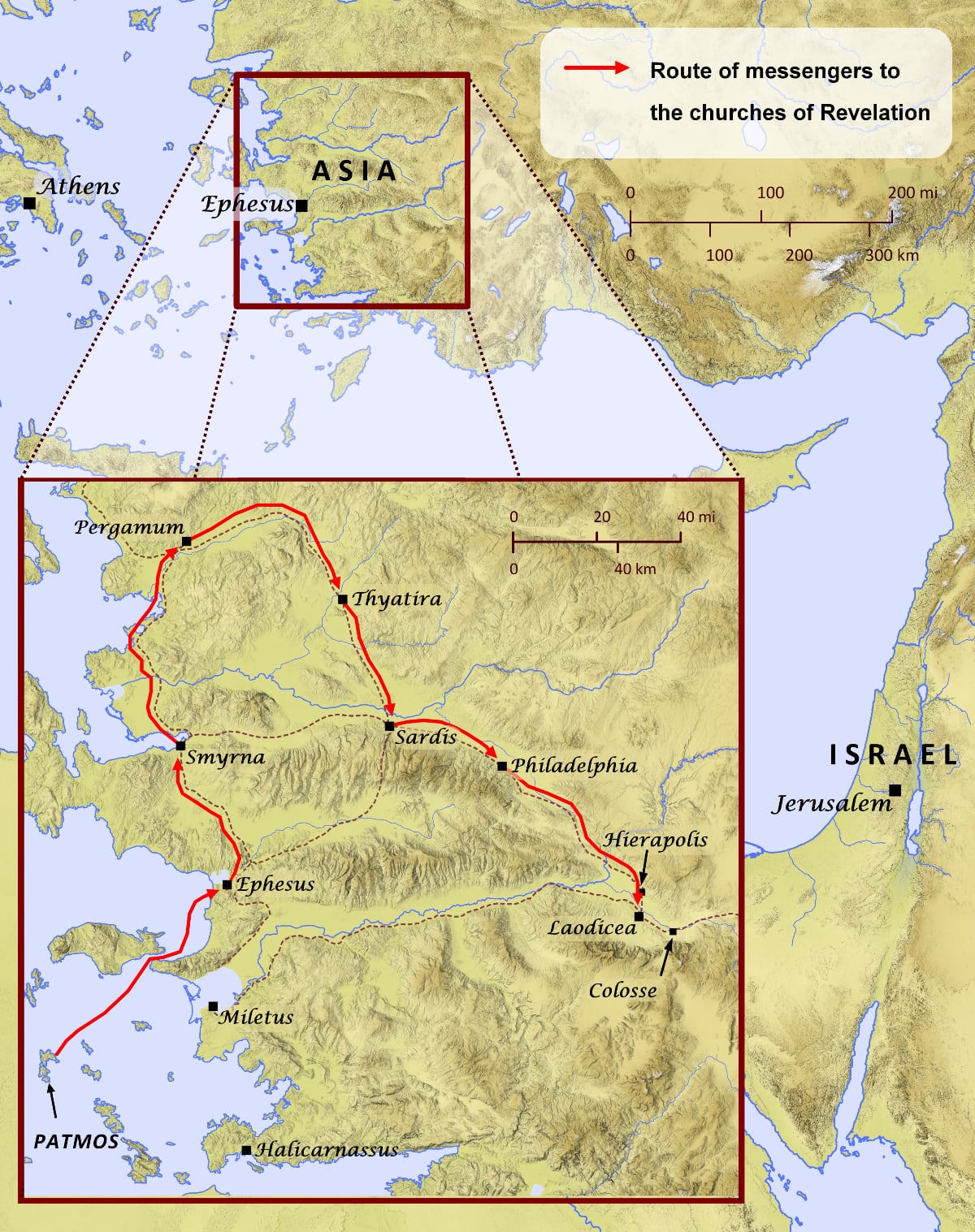
Image from https://biblemapper.com/
The KJV/TR opens the command with "I am Alpha and Omega, the first and the last: and," and addresses the churches "which are in Asia"; the critical text carries neither, reading ὃ βλέπεις γράψον εἰς βιβλίον καὶ πέμψον ταῖς ἑπτὰ ἐκκλησίαις — "What you see, write in a book and send to the seven churches."
Re 1:8, Re 1:11, Re 1:17, Re 2:8, Re 21:6, Re 22:13 — Majority Text – Here and in Revelation 22:13, the context favors Jesus as speaking, so "Alpha and Omega" in these places is best taken as his title. Elsewhere in Revelation, Jesus and the Father share divine titles, as in Revelation 1:8 (Father) and 1:17-18 (Jesus).
Re 2:1 — Ephesus
Re 2:8 — Smyrna
Re 2:12 — Pergamum
Re 2:18 — Thyatira
Re 3:1 — Sardis
Re 3:7 — Philadelphia
Re 3:14 — Laodicea
John Sees Glorified Jesus
The KJV/TR reads "seven lampstands" here; the critical text reads ἐν μέσῳ τῶν λυχνιῶν — "in the midst of the lampstands" — without the number.
Re 1:13, Re 14:14
Re 1:13, Re 15:6 — Soft link to priestly garments. Jesus is girded about the μαστοῖς "mastos," the upper chest, not the loins here. In 15:6, seven messengers have the same type of dress.
This is the only time wool is used and that is strictly related to the Lamb.
Does "white" apply to both head and hair? Yes, λευκαὶ applies to κεφαλή (head) + τρίχες (hairs)
Re 1:16, Re 12:1 — This is like the woman with the 12 stars, but they are not the same. The 7 stars seem to represent Gentile church messengers or leaders, while the 12 stars in Revelation 12 appear to represent the heads of the tribes of Israel.
The KJV/TR reads λέγων μοι — "saying unto me"; the critical text reads λέγων — "saying" — without "unto me."
Re 1:17, Re 2:10
The KJV/TR closes the declaration with "Amen"; the critical text lacks it here.
Re 1:18, Re 6:8, Re 20:13-14
In light of Revelation 1:19, chapters 1–3 focus on what is present and what will follow. When the vision reaches Revelation 4, the emphasis shifts exclusively to “what must take place after these things.”
Re 1:1, Re 1:3, Re 1:19, Re 4:1, Re 22:6, Re 22:10 — The primary direction of the word of Revelation is toward the future. However, it is set in the context of the current time. Notably, the past is not the concern of the book of Revelation, so we will not see anything here from John's time into the past.
Seven Churches
Important Note: It is not a highly important theological detail in the study of Revelation, but it is worth noting that there is debate over whether the seven stars in Revelation 1 represent angels or the human leaders of the churches. Also, all the churches are told to "hear." We will see this again in Revelation 13:9, when the saints are given the choice to worship the beast or likely be killed. This kind of connection might lead one to think the church is destined for the tribulation. Yet the call to "hear" is not a link to identity but to obedience — a call directed to a particular people, the saints, whether outside or inside the tribulation.
Bookends: There are bookends within the messages to the seven churches. The bookends are the opening and closing churches that need to return to God: Ephesus and Laodicea.
See the 12 stars in Chapter 12; these appear to point to the tribe heads of Israel in Chapter 12, while these 7 stars are connected to the messengers of the churches. If the church messengers are understood as human representatives, both star images would then involve human leaders within their respective groups.
The seven-and-twelve pattern also has support from the two feeding miracles. In the feeding of the five thousand, the setting is Jewish/Galilean and twelve baskets remain (Matthew 14:20; Mark 6:43; Luke 9:17; John 6:13), naturally fitting Israel's twelve tribes. In the feeding of the four thousand, the narrative follows Jesus' movement through Tyre, Sidon, and the Decapolis region, a Gentile or half-Gentile setting, and seven baskets remain (Matthew 15:29-39; Mark 7:31; 8:1-10). Jesus Himself keeps the twelve and seven basket counts distinct when He recalls both miracles (Matthew 16:9-10; Mark 8:19-20). This does not prove the Revelation imagery by itself, but it gives textual, historical, and geographical support for reading the seven stars as Gentile church messengers and the twelve stars as Israelite tribal heads.
“mystery” (μυστήριον) appears four times in Revelation and is applied specifically to the identity of two symbolic elements: the “seven stars” in Jesus’ right hand and “Mystery Babylon.” When we examine Mystery Babylon in its extended treatment (Revelation 17–19), she is set in deliberate contrast to the bride of Christ, the New Jerusalem. If the bride stands as the counterpart to this “mystery” city, and the seven stars are likewise called a “mystery,” the text may be suggesting a parallel in kind. In that case, the seven stars need not be understood strictly as heavenly angels, but could instead represent specific members within the body of the bride.
In the closing clause the KJV/TR repeats the relative clause — αἱ ἑπτὰ λυχνίαι ἃς εἶδες, "the seven lampstands which you saw"; the critical text reads αἱ λυχνίαι αἱ ἑπτὰ — "the seven lampstands" — without it.
Re 1:20, Re 10:7, Re 17:5, Re 17:7 — μυστήριον — Mystery is used four times. In Rev 1, the mystery concerns the seven stars and the seven lampstands, with the lampstands explicitly identified as the churches. In Rev 10, the "mystery of God" that is "finished" is unclear: whether the "mystery" refers broadly or specifically. When we look at the uses of mystery in Rev 17, both instances refer to Mystery Babylon. In 3/4 uses of "mystery," it is either tied to the churches or to Babylon. What is striking is that Mystery Babylon is directly contrasted with the image of New Jerusalem (17:3, 21:10). If there is meant to be a connection using the word μυστήριον, then it may be to reinforce the contrast of these two women. This may shed light on what Rev 10 describes as the mystery. The Mystery of God (that is, the one who is his) is the church (Ephesians 3:4-6). If this relation is true for Rev 10, then μυστήριον refers twice to the church and twice to Babylon.
Linear Scene 1.1: Jesus sent His messenger to John to share the end-times signs, timeline, and church corrections and encouragements. This messenger appears to be a prophet based on Revelation 22:9, where he identifies himself as a fellow servant with John and with John's brethren the prophets. Jesus will speak to the seven churches, telling them all to overcome, and we will see that call for the church to overcome again at the end in Revelation 21:7. Chapters 1–3 are present and future in nature: they are addressed to real churches in John's day, while also aiming forward toward the things that “must shortly come to pass” and the “things which shall be after this.” This is a core understanding that must frame our interpretation of the text. When the vision reaches Revelation 4, Jesus explicitly says, “I will show thee things which must be hereafter,” and this study reads the main prophetic details that follow under that forward-looking claim. The woman with 12 stars who gives birth, the fall of Mystery Babylon, and the arrival of the New Jerusalem out of heaven are future events within that framework.
Important Note: When Revelation speaks about overcoming, it connects back to John’s earlier writings. In 1 John 5:4-5, John explicitly links overcoming to one central truth: believing that Jesus is the Son of God. Revelation continues this same line of thought, describing those who overcome as those who are “washed in the blood of the Lamb.” This does not exhaust every way Revelation speaks of overcoming, since endurance, testimony, and faithfulness are also part of the book's call. But from a salvation standpoint, no act is given greater weight than being found in Christ and washed in His blood.
Bookends: In the main story, we have the bookends of the blessings of “the words of this prophecy.” Yet greater, the “Alpha and Omega” speaks, opening and closing the book.