Article
Are the Seven Churches Seven Ages of the Church?
Some readers take the seven letters of Revelation 2–3 as seven periods of church history. The text names seven real churches and tells every church to hear every letter; it says nothing about ages. This study reads the seven as seven historical churches whose words apply for as long as the church exists.

Some readers take the seven letters of Revelation 2 and 3 as a map of church history, with each church standing for a period of the church from John’s day to the end. The question for this study is not whether that reading can be made to fit. The question is whether the text asserts it.
It does not. In all of the text, the assertion is not present. Reading the churches as ages is an interpretive call made on the reader’s behalf, not something the text emits.
Seven Historical Churches
The book names them: “John unto the seven churches that are in Asia” (Revelation 1:4, URV), and then, “What you see, write in a scroll and send it unto the seven churches; to Ephesus, and to Smyrna, and to Pergamum, and to Thyatira, and to Sardis, and to Philadelphia, and to Laodicea” (Revelation 1:11, URV). Seven cities, one scroll, sent to all seven at once.
Nothing in the letters says that one church follows another in time. No letter carries a date, an era, or an “after this church comes another.” Each letter speaks to the condition of that church in its own moment, and where Jesus speaks of time to a church, the time is the church’s own. The span of the letters is not defined in terms of millennia. The text gives no such measure, and a reading that supplies one is supplying it.
The Number May Speak for the Whole
Seven is the book’s number for a complete set: seven Spirits, seven seals, seven trumpets, seven bowls. Seven churches may well present the seven as standing for the church as a whole.
The text itself supplies the widening. Every letter carries the same call, in the plural: “He who has an ear, let him hear what the Spirit says unto the churches” (Revelation 3:22, URV). The letter to Ephesus is to be heard by all seven churches, and so is each of the others. The sayings apply directly to the real seven, and the seven serve as an example to the church as a whole by the number of churches selected. At the close of the book the same reach is stated again: “I, Jesus, have sent my messenger to testify unto you these things [in/for] the churches” (Revelation 22:16, URV).
How long do the letters apply? For as long as the church exists.
Order and Poetry
The letters are arranged with care, and the arrangement can be seen in the text. This study titles the seven messages by their mirrored themes, and the outline is chiastic:
| Pair | Church | Theme | Passage |
|---|---|---|---|
| A | #1 Ephesus | Left Jesus: left first love | Revelation 2:1–7 |
| B | #2 Smyrna | Crown: ten days of tribulation | Revelation 2:8–11 |
| C | #3 Pergamum | Fornication: doctrine of Balaam | Revelation 2:12–17 |
| C | #4 Thyatira | Fornication: Jezebel | Revelation 2:18–29 |
| D | #5 Sardis | Dead: I come as a thief | Revelation 3:1–6 |
| B | #6 Philadelphia | Crown: open door | Revelation 3:7–13 |
| A | #7 Laodicea | Left Jesus: Jesus outside | Revelation 3:14–22 |
The first and last churches, Ephesus and Laodicea, have left Jesus and stand under threat: the first has left its first love and is told its lampstand will be moved unless it repents (Revelation 2:4–5); the last is lukewarm, about to be vomited out, and Jesus stands outside its door (Revelation 3:16, 20). The second and sixth, Smyrna and Philadelphia, receive no rebuke, each has a crown in view, the crown of life promised to Smyrna and the crown Philadelphia is told to hold fast (Revelation 2:10; 3:11), and both face “those who say they are Jews, and are not” (Revelation 2:9, URV; and 3:9). The third and fourth, Pergamum and Thyatira, share one charge, things sacrificed to idols and fornication (Revelation 2:14, 20). The fifth, Sardis, stands on its own, unpaired, just past the center: “you have a name that you live, and are dead” (Revelation 3:1, URV). The text is being holistic, and the structure is chiastic in its mirroring.
The order of the seven cities is also the order of a possible delivery route for the one scroll, from Ephesus north to Smyrna and Pergamum, then inland and southeast through Thyatira, Sardis, and Philadelphia to Laodicea. The route and the chiastic arrangement may correspond.
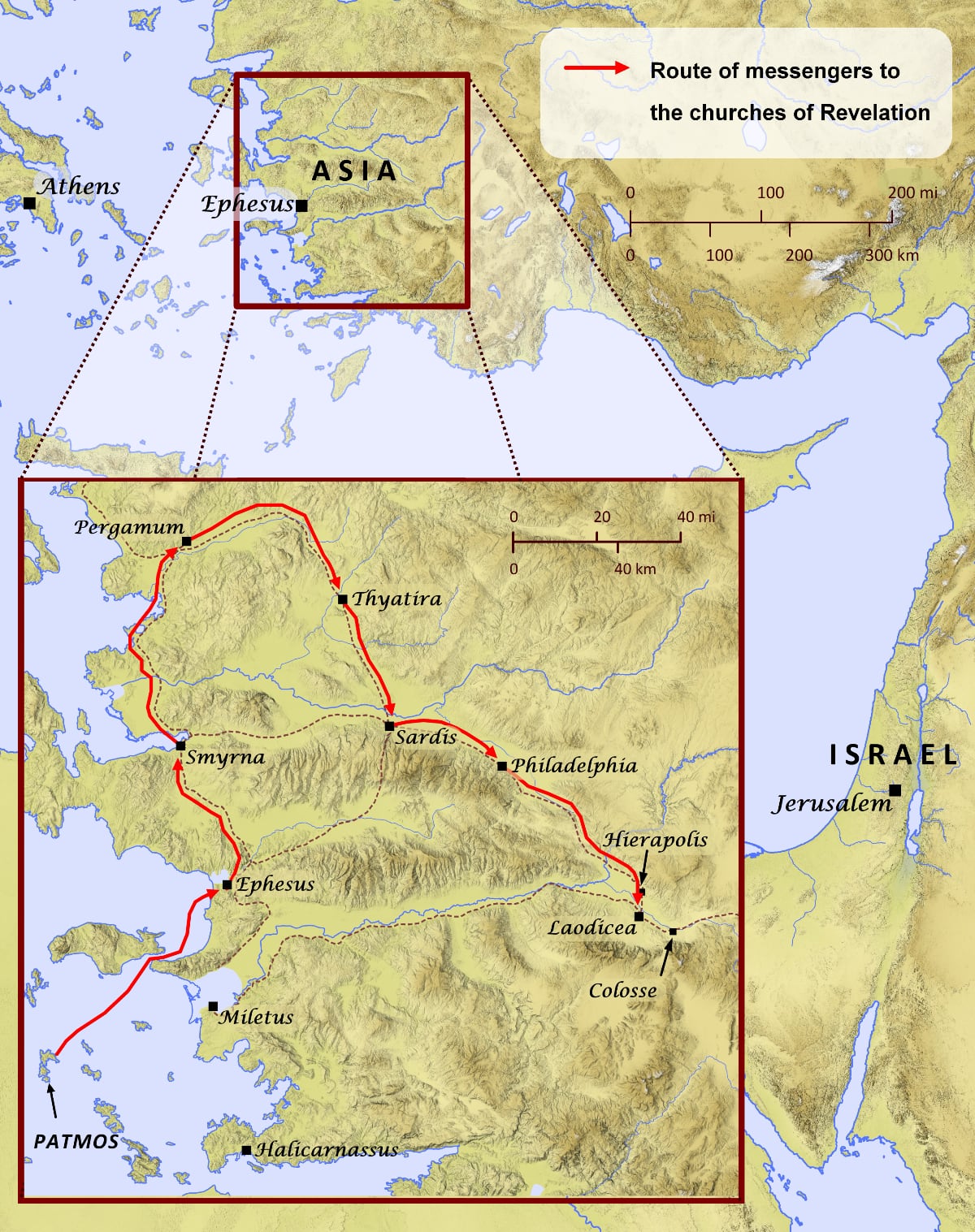
That structure communicates order and poetry. It does not carry a timetable, and the text does not say that it does. A structure should not be inflated to take on more meaning than what is communicated. Matching the churches to denominations, or to phases of the church, loads the seven with meaning the text does not emit.
What Revelation 4:1 Divides
Jesus tells John to write “the things which you have seen, and the things which are, and the things which are about to come to pass after these things” (Revelation 1:19, URV). The letters stand in “the things which are,” and they point forward as well. Then the voice at the door says, “Ascend here, and I will show you the things which must come to pass after these things” (Revelation 4:1, URV). “These things” are the matters just addressed to the churches. How Revelation Places Its Prophecy in Time lays out that map.
Revelation 4:1 provides a clear division of time into the future. That division does not negate the existence of the church during the seven years this study finds laid out in the book, and it does not mean that the church is not the subject of “these things” that come before the future things. Having spoken to the church, the book turns to a new phase of time, and the focus moves from the church on earth to the saints in heaven and to the judgments that come after the words to the churches: judgments on the whole world, carried through to the new creation. The word “church” does not appear between 4:2 and 22:5, but saints do: “Here is the patience and the faith of the saints” (Revelation 13:10, URV), and “Here is the patience of the saints” (Revelation 14:12, URV).
So “present and future church,” as this study uses the phrase, means this: the letters were written to seven real churches in John’s day, and they speak to the church for as long as the church exists, the church that stands in the tribulation included. The phrase does not mean seven eras, and it does not mean that a church in the tribulation is a different body from the church addressed in chapters 2 and 3. Where the church stands during the seven years is a separate question, taken up in Would God Send Christ’s Bride Into the Tribulation? and Where Does the Catching Up Belong in Revelation?.
Let the Seven Be Seven
The seven churches are seven historical churches. Their number may present them as the church whole, and the call to hear sends every letter to every church. The arrangement of the letters is ordered and poetic. None of that places the churches on a calendar, and the text never says that it does.