Article
When “Voice” Means “Sound” in Revelation
The Greek word translated “voice” can identify speech, but it can also describe nonverbal or collective sound. Revelation 14:2 shows why the context must decide.

When Revelation says John heard “a voice,” the English wording can lead us to picture a single identifiable speaker. The Greek word for “voice” (φωνή), which appears in Revelation 14:2 as φωνήν, names what is heard more broadly. It can identify speech when the passage supplies spoken words, as when John hears “a voice out of heaven saying, Write” in Revelation 14:13 (URV). But φωνή can also identify an audible sound without identifying a speaker. The word tells us that something was heard; the surrounding description tells us what kind of sound it was.
Revelation demonstrates that flexibility with things that do not speak. The same word describes “the voice of their wings” in Revelation 9:9 (URV), where the sound is compared with chariots, and “the voice of a millstone” in Revelation 18:22 (URV). It can also gather a collective sound into one heard phenomenon. In Revelation 19:6, John hears what is like the voice of a multitude, many waters, and strong thunders. A φωνή may therefore be one person speaking, a nonverbal noise, or a combined sound produced by many sources. Rendering the word as “voice” can be correct, but the English word should not make us assume a distinct speaker when the context does not identify one.
Revelation 14:2 as the Example
“And I heard a voice out of heaven, as the voice of many waters and as the voice of a great thunder, and the voice which I heard was as of harpers harping with their harps.”
— Revelation 14:2 (URV)
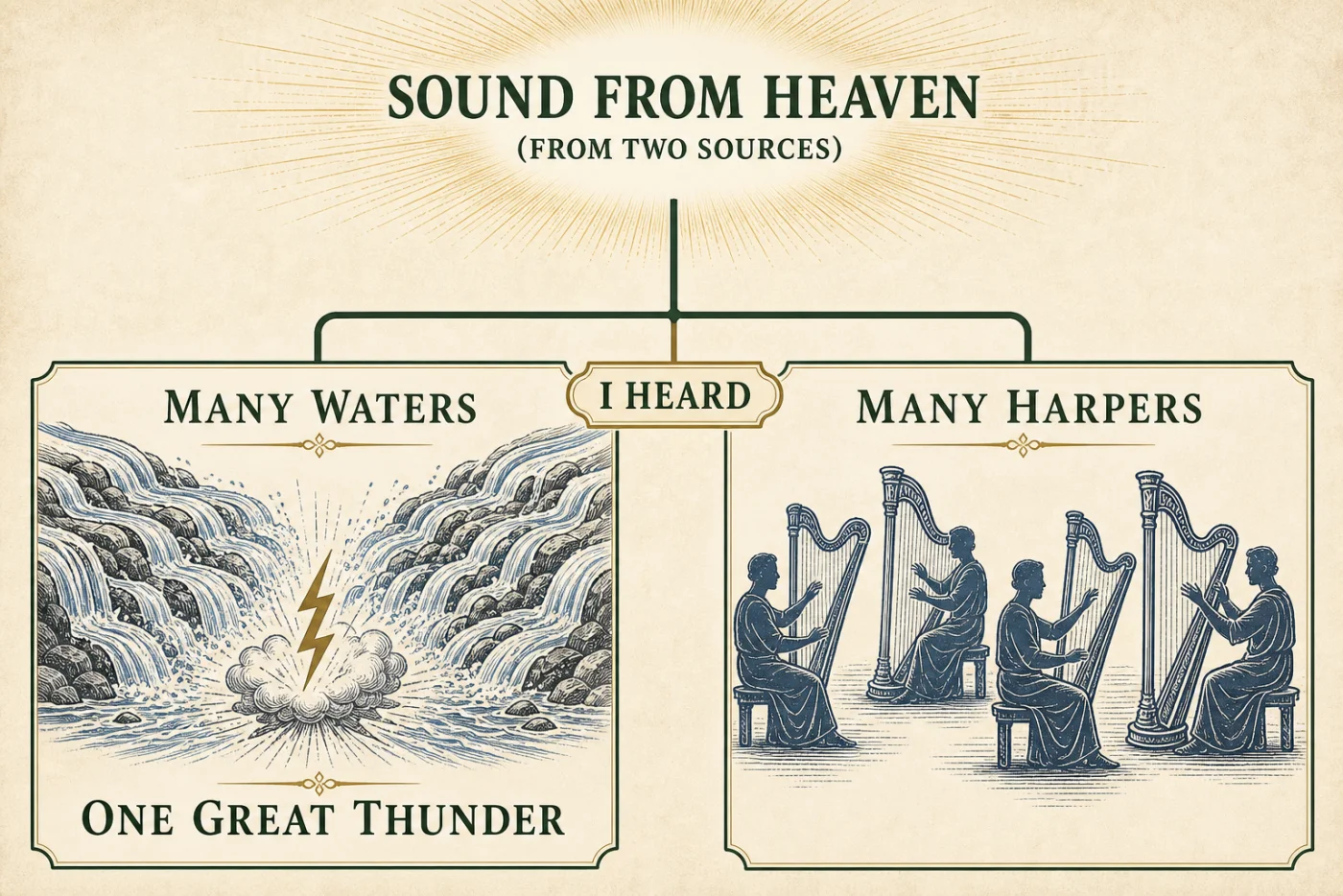
Revelation 14:2 brings this range together in one sentence, but it does not place the waters, thunder, and harpists into one uninterrupted list. First, John compares the sound from heaven with the sound of many waters and with the sound of one great thunder. Then John does not merely add another “voice of” comparison. He restarts the description: “the voice which I heard was as of harpers harping with their harps” in Revelation 14:2 (URV). The key to the division is the added “I heard.” The English “the voice I heard” reflects “the sound which I heard” (ἡ φωνὴ ἣν ἤκουσα). Those words reach back to the sound from heaven and resume it before John turns to a plurality of harpists.
Revelation 19:6 shows how John can leave several sound comparisons in one uninterrupted series: a multitude, many waters, and strong thunders. The repetition of “voice” by itself therefore does not create the division in Revelation 14:2. The unique feature is that “I heard” is used twice for the same sound: first John says that he heard a sound from heaven, and then he returns to the sound which I heard. Revelation 4:1 and 10:8 use similar resumptive wording, but those occurrences reach back to sounds heard in earlier verses. Only Revelation 14:2 introduces the sound with "I heard" and then repeats "I heard" while resuming the same sound within the sentence.
That second “I heard” is the point of division. The first part compares the heavenly sound with many waters and one great thunder. The second part compares the resumed sound with harpists playing their harps. This division supports the understanding that one sound from heaven has two distinguishable parts: first, the sound of many waters and thunder; then, the sound of the harpists. It need not collapse the waters and thunder into descriptions of the harpists.
 The same care should be used wherever “voice” appears in Revelation. We should ask what produces the sound and whether the passage actually gives spoken words. When a voice is “saying” something, speech is in view. When the sound is compared with waters, thunder, wings, instruments, or a millstone, “sound” may be the better category for understanding the scene. A sound coming from one place does not, by itself, require that one person be speaking from that place.
The Traditional Reading
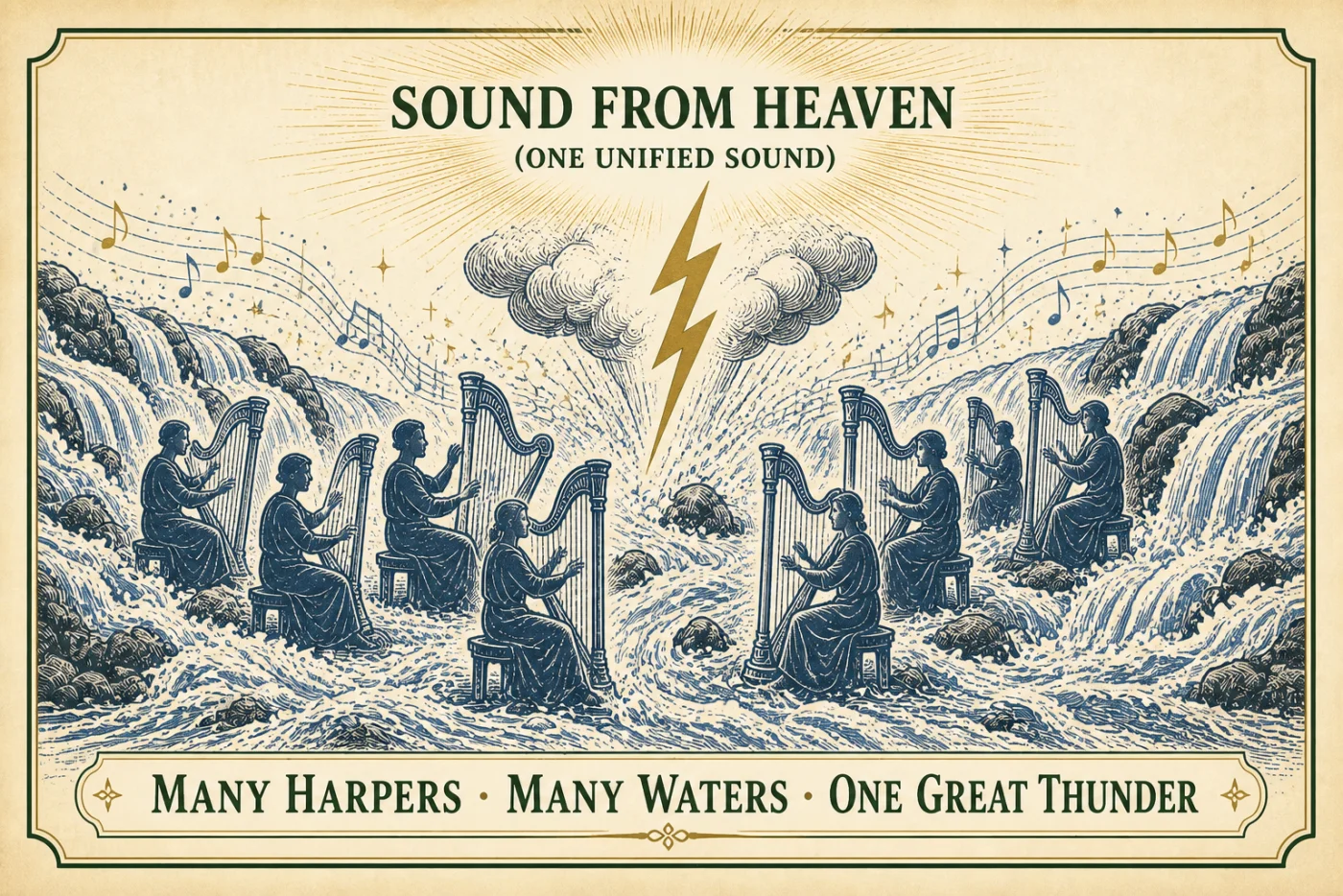
The traditional reading treats Revelation 14:2 as one unified sound from heaven. On this reading, the sound comes only from the harpists: their harping sounds like many waters and like one great thunder. The unity is found in the singular phrase “a great thunder”—many harpists producing one thunder-like sound. This is a valid possible understanding of the text. However, it does not fully account for John’s sharp restart: “the voice I heard.” John inserts “I heard” again. The first occurrence introduces the sound from heaven; the second resumes that sound before the comparison with the harpists. The singular “great thunder,” followed by the plural “harpists,” also gives this verse a distinctive structure.
Taken together, these details point toward a likely division between two sounds coming from the same place. The sound of many waters, heard as one great thunder, appears alongside many harpists harping with their harps. The reader must therefore determine from the context whether φωνή is better understood as “voice” or “sound,” and whether what is heard comes from one source or several. The word φωνή by itself does not determine whether what John hears is singular or plural. This is why Revelation 14:2 is such a useful example: one word can encompass several audible phenomena, and the structure of the verse must tell us how those sounds relate.