Article
Who Sits on the Great White Throne
Revelation never names the one seated on the great white throne. But the book has its own settled way of speaking about thrones, and its language at 20:11 reaches back to a scene it has already given us. Read with Matthew 25 and John 5, the picture is coherent rather than crowded.
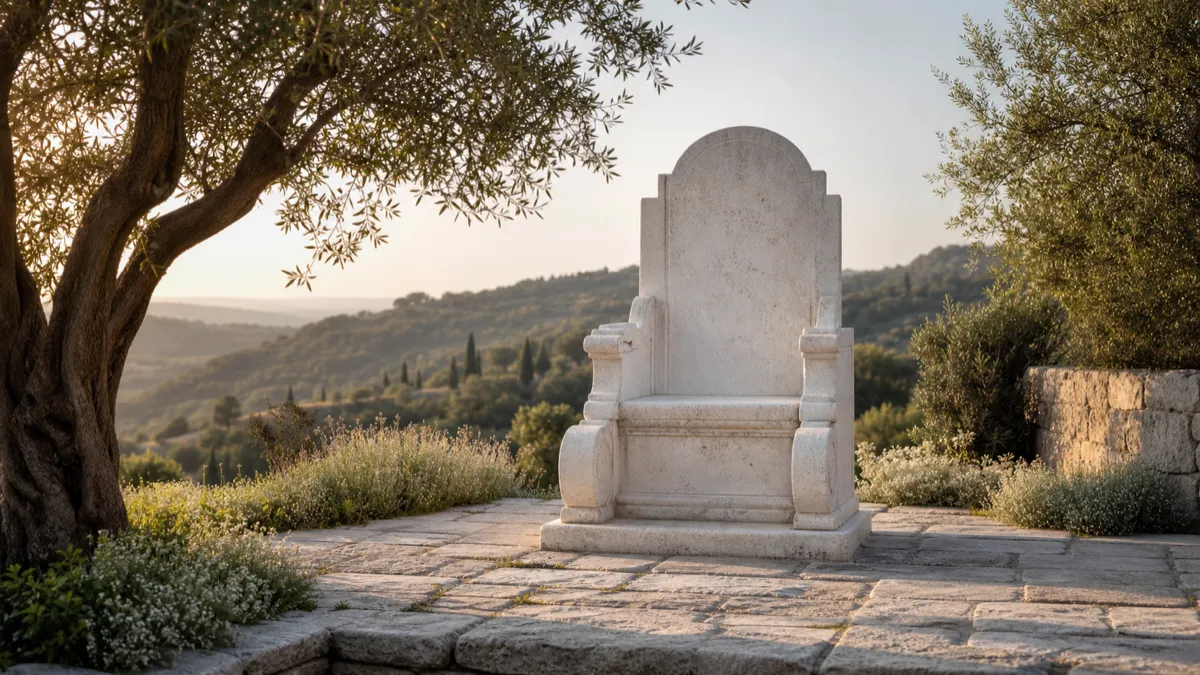
Revelation 20:11 opens the last judgment without introducing the judge: "And I saw a great white throne and him who sat on it, from whose face the earth and the heaven fled, and no place was found for them" (URV). A throne, an occupant, and a creation that will not stay in the room. The verse does not say who he is.
That silence is worth sitting with rather than filling in quickly. Revelation is not careless with thrones, and the answer does not have to be imported from outside the book. Revelation has its own settled way of speaking about the one who sits, and 20:11 is written in that same language.
Revelation's Own Designation
Throughout the book, "the one seated on the throne" is consistently distinguished from the Lamb, and therefore identified as the Father (4:2-3, 9; 5:1, 7, 13; 6:16; 7:10; 19:4; 21:5).
The distinction is not subtle. It is at its most explicit in Revelation 5:7, where the Lamb approaches the throne to take the book: "And he came and took the book out of the right hand of him that sat upon the throne." Two figures, one act, no ambiguity. The Lamb is the one who comes; the one seated is the one who is come to.
The distinction is equally explicit in Revelation 6:16, where the terrified of the earth call for cover "from the face of him that sitteth on the throne, and from the wrath of the Lamb." Again two, named side by side and kept apart in the same breath.
This is a designation, not a passing description. Revelation uses one word for it throughout — ὁ καθήμενος, "the one seated" — and it lands on the same figure every time.
Revelation 20:11 Is Less Explicit
The great white throne is introduced differently. It is not presented as the heavenly throne of chapters 4 and 5, the one encircled by the four living creatures and the twenty-four elders. It arrives on its own, white and great, with no attending court described.
That difference is real and should not be waved away. But a different setting does not require a different occupant, and the verse supplies a verbal connection that points back.
At 20:11 the earth and the heaven flee "from whose face" — οὗ ἀπὸ τοῦ προσώπου. The same word, πρόσωπον ("face" or "presence"), carries the reaction at 6:16, where the inhabitants of the earth beg the mountains and rocks to hide them ἀπὸ προσώπου τοῦ καθημένου ἐπὶ τοῦ θρόνου, "from the face of the one seated on the throne."
The parallel is not only the word. It is the whole picture. In chapter 6, that cry comes immediately after the sky has withdrawn: "And the heaven was parted as a scroll when it is rolled up; and every mountain and island were moved out of their places" (6:14). At the great white throne, the same creation does the same thing, and there is no longer anywhere for it to go — "no place was found for them" (20:11). Twice, the created order recoils from the presence of the enthroned one. The second time, it does not come back.
The shared throne designation and the repeated recoil from the enthroned one's πρόσωπον support identifying the occupant of the great white throne with the Father — while recognizing that the verse itself does not name him. This is an inference the text invites, not a statement the text makes.
One textual note belongs here, because it cuts against the easy reading. The King James, following the Received Text, has the dead "stand before God" at 20:12. The critical text reads ἐνώπιον τοῦ θρόνου, "before the throne." The manuscripts this study follows do not hand us the identification; they leave the throne unattributed. The case has to be made from Revelation's own usage, which is exactly what the πρόσωπον link does.
Does This Conflict With Matthew 25?
At first glance, yes. Jesus describes himself as the one who conducts the final judgment: "When the Son of man shall come in his glory, and all the holy angels with him, then shall he sit upon the throne of his glory: and before him shall be gathered all nations: and he shall separate them one from another, as a shepherd divideth his sheep from the goats" (Matthew 25:31-32). The Son of man takes his judicial seat, separates the nations, and pronounces the sentences.
If the Father is seated at Revelation 20:11, who is judging?
Revelation answers by not answering. It never says that the one seated performs the judgment. Twice it says the dead "were judged" (20:12, 20:13), and neither time does it say who judged them. The books are opened and the sentence falls, but Revelation never names the hand that carries it out.
That is not an oversight to be patched. The silence is a gap the rest of Scripture is shaped to fill, and Matthew 25:31-46 fills it: the Son of man is the one who separates and pronounces.
Sharing the Throne Without Blurring the Persons
Revelation has already established that the Son can occupy the Father's throne. "To him that overcometh will I grant to sit with me in my throne, even as I also overcame, and am set down with my Father in his throne" (3:21).
The verse gives the sharing and the distinction in the same sentence. Jesus sat with the Father — not instead of him or in place of him — and the throne is expressly called the Father's, "his throne."
The wording differs too. What Jesus says of himself in 3:21 is a different Greek word (καθίζω) from the one behind Revelation's standing designation, "the one seated" (κάθημαι). The two overlap in ordinary use, so the difference by itself settles nothing.
The relational language is what settles it. Jesus shares the Father's throne and royal authority with him, while remaining personally distinct from the Father who occupies it. Revelation keeps the two distinct all the way through — the Lamb approaches the one seated in chapter 5 — but that personal distinction never implies separation in rule, purpose, or divine unity. Their individual identities are preserved while their authority is exercised in perfect unity.
So the Father may be identified as the one seated upon the great white throne, while Jesus, sharing the Father's throne and authority, executes the judgment Matthew 25 describes. The two descriptions are complementary rather than contradictory.
John 5 Supplies the Framework
John's Gospel explains how this works, and it does so in the same discourse.
"For the Father judgeth no man, but hath committed all judgment unto the Son" (John 5:22). And the reason given for that commission is the very title Matthew 25 uses: "And hath given him authority to execute judgment also, because he is the Son of man" (John 5:27).
Then Jesus describes the manner of it: "I can of mine own self do nothing: as I hear, I judge: and my judgment is just; because I seek not mine own will, but the will of the Father which hath sent me" (John 5:30).
Jesus does not describe his judging as independent of the Father. He describes it as the execution of what he hears from the Father, and of the Father's will. That is a framework for Revelation 20:11-15. The Father's presence upon the great white throne represents the sovereign authority and will from which the judgment proceeds; the Son carries out that judgment in perfect agreement with him.
Matthew 25:31-46 presents Jesus seated on his judicial throne and pronouncing the sentences — though Revelation 20:11-15 does not mention that throne or name Jesus as the acting judge. The books opened in Revelation 20:12 provide the recorded basis according to which the dead are judged, but the text does not say that these books are what Jesus "hears." John 5:30 points most directly to the Father as the one whose will the Son hears and executes.
On this reading: the Father presides upon the great white throne, the books disclose the works to be judged, and the Son administers the judgment in complete unity with the Father.
There is also a timing to it. Jesus can execute this judgment as the one who has finished putting all things under his feet — "For he must reign, till he hath put all enemies under his feet" (1 Corinthians 15:25) — which is where Revelation 20 stands, after the thousand years, at the last judgment.
Nothing Has to Be Forced
What is worth noticing is how little strain this takes.
Revelation supplies a fixed designation and then uses it consistently. Twice it says the dead were judged without saying who judged them. It establishes beforehand that the Son sits on the Father's throne without displacing him. Matthew supplies the Son of man on the judgment seat. John supplies both the commission and the manner — all judgment given to the Son, exercised as the Father's will and not his own.
And laid side by side, the evidence leans one way. Revelation has a settled phrase for the throne's occupant, and everywhere it appears before chapter 20 it means the Father — twice with the Lamb standing right there, plainly distinct from him (5:7; 6:16). At 20:11 the book reaches for that same phrase, and pairs it with the same reaction it has used once before: creation fleeing the enthroned one's face. Nothing in 20:11-15 hands the judging to the one seated, so Matthew 25 is not competing for the seat. And 3:21 has already shown that the Son can share that throne without displacing whoever occupies it.
Taken alone, none of these settles who sits on the great white throne. Together they point in a single direction, and nothing in the passage pulls the other way. The verse does not name him, and this article will not pretend that it does — but the weight of Revelation's own usage falls on the Father.
No passage has to be bent to fit another. The silence at Revelation 20:11 is not a gap in the account; it is the seam where Revelation's own system meets the Gospels', and the pieces were cut to fit.