Listen to Chapter 1
Chapter 1
Revelation of Jesus Christ
Ἀποκάλυψις Ἰησοῦ Χριστοῦ
The Book of Revelation was likely written by the Apostle John during his exile on Patmos near the end of Emperor Domitian’s reign, around A.D. 90 (commonly dated between A.D. 85–95), as affirmed by early church testimony (Irenaeus, Victorinus of Pettau, Eusebius, Jerome). While the exact year is uncertain, historical and textual evidence place its composition near the close of the 1st century. All existing manuscripts of the Book of Revelation are preserved in Greek, including early witnesses such as the Codices Sinaiticus and Alexandrinus. However, the text’s linguistic character is highly Semitic, displaying grammatical constructions, idioms, and patterns of parallelism that reflect a Hebrew or Aramaic texts. These features indicate that John was composing within that context. The book’s vocabulary and imagery draw heavily from the Hebrew Scriptures, giving Revelation a distinctly Jewish prophetic style.
Understand Revelation Version (URV) and URV Interlinear, produced by Kevin Dees, updated last 29 November 2026.
Greek manuscript resources: Center for New Testament Restoration, Center for the Study of New Testament Manuscripts, Codex Alexandrinus and Codex Sinaiticus.
Start here: How to Read This Study and How to Approach Reading Revelation.
The Revelation of Jesus Christ to the Churches: Overcome
The Greek verb σημαίνω carries the sense of “to give a sign,” “to signal,” “to point out,” “to indicate,” “to make clear,” “to make known,” “to communicate information,” “to report,” “to disclose,” or “to signify.” Thus, in Revelation 1:1, ἐσήμανεν may be understood as “He made it known,” “He communicated it,” or “He signified it.” The word can involve communication through signs, but it does not, by itself, require the meaning “to make symbolic.”
The draft renders ἐσήμανεν as “he signified it,” keeping the sign-root in view; the Greek could equally be heard as “he made it known,” “communicated it,” or “indicated it.” “Signified” does not, by itself, make the communication symbolic. This does not mean that every detail in Revelation is symbolic, but it does show that the book itself allows for symbolic communication. This is not only suggested in the opening verse; it is explicitly demonstrated when Jesus interprets the seven stars and the seven lampstands for John: “The seven stars are the messengers of the seven churches, and the seven lampstands are the seven churches.” (Revelation 1:20). Therefore, Revelation should not be forced into a purely literal reading at every point. The lampstands are real features within John’s vision, but they are not merely literal lampstands; they signify the churches, portrayed through the heavenly image of light-bearing stands before Christ.
Re 1:1, Re 1:3, Re 1:19, Re 4:1, Re 22:6, Re 22:10 — The primary direction of the word of Revelation is toward the future. However, it is set in the context of the current time. Notably, the past is not the concern of the book of Revelation, so by default we do not expect to see anything here from John's time into the past. Revelation 4:1 sets that default for the events John is shown: “the things which must come to pass after these things.” Where the text itself says something is past or present, as with the seven kings, “the five have fallen, the one is” (17:10), the text has made the exception explicit. Without that time reference, any event could be placed in any time at will.
Re 1:1, Re 22:16 — Bookend — "sent my messenger"
The Received Text reads ὅσα τε — "and as many things as" — where the critical text has a bare ὅσα, joining the clause with no conjunction at all. The King James renders the particle "and"; this edition keeps the word the particle buys visible as "even" and marks it, the same way 3:4 marks the Received Text's καί. The critical reading is simply asyndetic: "…the testimony of Jesus Christ, all things that he saw."
Reading would be out loud
Re 1:3, Matthew 24:15, Mark 13:14 — "The reader" is the Greek ὁ ἀναγινώσκων, "the one reading," and this exact form occurs only three times in the New Testament: here, Matthew 24:15, and Mark 13:14. In both Gospels it stands inside Jesus's Olivet discourse, "let the reader understand" (Matthew 24:15, ESV), and every use of the verb in Matthew and Mark, eleven in all, is Jesus speaking: "Have you not read" (Matthew 12:3, 12:5, 19:4, 21:16, 21:42, 22:31; Mark 2:25, 12:10, 12:26), then this clause in both Olivet accounts. Speaking in the third person to whoever receives his words is Jesus's own habit in the Synoptic Gospels: "He who has ears to hear, let him hear" (Matthew 11:15, ESV; also Matthew 13:9, 13:43; Mark 4:9, 4:23; Luke 8:8, 14:35), words that reach past the people in front of him to the hearer wherever he is, and Revelation keeps the same idiom, "He who has an ear, let him hear" (Revelation 2:7, URV). Jesus also speaks with the telling of his own story in view. At Bethany he says of the woman who anointed him, "wherever this gospel is proclaimed in the whole world, what she has done will also be told in memory of her" (Matthew 26:13, ESV; also Mark 14:9), a word spoken before any Gospel was written, about what the Gospel would carry to the world, and it stands in the same two Gospels, two chapters after "let the reader understand." "Let the reader understand" has exactly the shape of the hearer formula, a third-person "the one reading" with a third-person command, which is Jesus's way of addressing the one who receives the word, not an editor's. The Greek text has no parenthesis; the parentheses around the clause are an editorial mark, already printed in Stephanus's 1550 edition, carried into the KJV, "(whoso readeth, let him understand:)" (Matthew 24:15, KJV), and kept by modern translations. This study reads the clause as Jesus's own words, not an aside by the evangelist, and holds that the parenthetical renderings take the words out of his mouth. The common explanation makes "the reader" the reader of Daniel, whom Matthew names just before the clause, and Mark mirrors Matthew there, with the same clause at the same point in the discourse (Mark 13:14). For the record, the manuscripts differ at Mark 13:14: the words "spoken of by Daniel the prophet" are carried by Codex Alexandrinus, the Byzantine text, and the Received Text, and are absent from Codex Sinaiticus, Codex Vaticanus, Codex Bezae, Codex Washingtonianus, and the critical editions, while at Matthew 24:15 Daniel is named in every witness. That difference should not be read as a clue to the meaning. Whether or not Mark names Daniel, the two options stand at both passages: the reader may be the reader of Daniel, or the reader of the Gospel in hand. Revelation 1:3 shows what the word means when it is used plainly: the reader is the one reading the text in hand. Read that way, Jesus is addressing whoever will read these words, the reader of Matthew and of Mark, which is prophetic speech reaching past the hearers on the mount to the reader of the Gospel itself, just as his word to the hearer reaches past those present and his word at Bethany reaches to wherever the Gospel is told. That possibility should not be set aside for the Daniel explanation, and the reader blessed in Revelation 1:3 is addressed by the same word.
Who pronounces the blessing at 1:3 is itself open, and this study does not settle it. John stands behind the opening as its writer, but he does not name himself until 1:4, "John unto the seven churches" (Revelation 1:4, URV); verses 1 through 3 run before that introduction. Elsewhere in the book the blessings that most resemble this one are in Jesus's own mouth: "Behold, I come quickly. Blessed is he who keeps the words of the prophecy of this scroll" (Revelation 22:7, URV), which repeats 1:3 almost word for word, and "Behold, I come as a thief. Blessed is he who watches" (Revelation 16:15, URV). That makes it plausible that the blessing at 1:3 is Jesus's, spoken through John before John speaks in his own name, and it would fit the pattern above, in which "the reader" is Jesus's word for the one who receives his words. But the text does not say who speaks at 1:3, and this is an observation of what is possible, not a matter of fact.
Re 1:3, Re 22:10 — Bookending — "the time is near."
Re 1:1, Re 1:3, Re 1:19, Re 4:1, Re 22:6, Re 22:10 — The primary direction of the word of Revelation is toward the future. However, it is set in the context of the current time. Notably, the past is not the concern of the book of Revelation, so by default we do not expect to see anything here from John's time into the past. Revelation 4:1 sets that default for the events John is shown: “the things which must come to pass after these things.” Where the text itself says something is past or present, as with the seven kings, “the five have fallen, the one is” (17:10), the text has made the exception explicit. Without that time reference, any event could be placed in any time at will.
Message to the Seven Churches: Peace From The Father, Seven Spirits, and Jesus
The throne is the Father's in the immediate logic of Revelation 1:4-5. Grace and peace come from Him who is, and who was, and who is to come; from the seven Spirits before His throne; and from Jesus Christ. The greeting distinguishes the Father, the seven Spirits, and Jesus, even though Revelation will later speak of the throne of God and of the Lamb together.
Greek: ἀπὸ ὁ ὢν καὶ ὁ ἦν καὶ ὁ ἐρχόμενος. ἀπό takes the genitive — as it does later in this same verse, ἀπὸ τῶν ἑπτὰ πνευμάτων — but the threefold title stands in the nominative in both the NA28 and SBLGNT. The text does not say why. It is commonly read as the title being held in one fixed form, but that is interpretation, not something the text states.
He is not just King of Kings but also prince or ruler, ἄρχων, of the kings.
“Released” (λύω) appears in the Critical Text, while “washed” (λούω) is found in the Majority Text; in Greek, these two verbs differ by only a single letter. Within Revelation’s broader context, Christ is portrayed as the one who ransoms and redeems, while the saints are primarily described as those who have washed their robes in the blood of the Lamb (7:14; compare 22:14) and who overcome because of that blood (12:11). Revelation also describes the saints by patience, testimony, commandments, and faithfulness (12:17; 14:12; 20:4), but those works are not presented as the ground of their worthiness. This pattern suggests that, in this instance, the sense of Christ freeing rather than washing is the more contextually fitting reading.
Re 1:5, Re 3:14
Re 1:5, Re 3:14, Colossians 1:18, Colossians 1:15
Re 1:5, Re 20:9
Kingdom of Priests unto God
Important Note: Textual variants cause Revelation 1:6 in some translations, such as the NASB 2020, to read, "He made us into a kingdom, priests to His God and Father" (Revelation 1:6, NASB 2020). Likewise, Revelation 5:10 reads, "You have made them into a kingdom and priests to our God, and they will reign upon the earth" (NASB 2020). The evidence strongly suggests that the intended theme is "a kingdom of priests," not KJV's "kings and priests" echoing Exodus 19:6: "And ye shall be unto me a kingdom of priests, and an holy nation" (KJV).
ἀμήν — "truly" for Amen
“[Of the ages]” follows the NA28’s own brackets ([τῶν αἰώνων]): Sinaiticus and Ephraemi carry the words, and SBL and the Received Text keep them, while Westcott-Hort and the Statistical Restoration omit them and Codex Alexandrinus lacks them. The doxology reads “unto the ages” or “unto the ages of the ages” accordingly.
The question also reaches 15:3, where the manuscripts split between “King of the [nations/ages].” Everywhere else in Revelation “ages” stands doubled — “unto the ages of the ages” — so if the words are absent here, the doxology’s bare “unto the ages” and 15:3’s “King of the ages” would be the book’s only two single uses of the word, and each makes room for the other. The settings match as well: both stand beside king and kingdom — “has made us a kingdom” here, “O King of the…” there. This study ranks the possibilities as fully equal — at 1:6 for the longer and the shorter reading, at 15:3 for “nations” and for “ages” — because the evidence is not strong enough to decide either place, and neither direction breaks the book’s continuity. So in both places the text is preserved as it stands.
Re 1:6, Re 5:13
Re 1:7, Re 10:1, Re 14:14-16, Daniel 7:13 — Jesus coming in the clouds.
Re 1:7, John 19:37, Zechariah 12:10 — This is making it very clear the type of death Jesus died and connecting him to the person who is coming in the clouds.
The KJV/TR adds "the beginning and the ending"; the critical text reads Ἐγώ εἰμι τὸ ἄλφα καὶ τὸ ὦ, λέγει κύριος ὁ θεός — the title continues without the expansion.
Companion in Tribulation
Important Note: John points out that, regarding the church, he is in tribulation, and the saints who will be in tribulation can be patient in Jesus as he is. The letters to the churches were present and future when delivered to the seven churches, and they are past to us only in that original historical setting. Revelation 1:19 frames the writing as “the things which you have seen,” “the things which are,” and “the things which are about to come to pass after these things,” so the letters apply to the original seven churches and to the church for as long as the church exists, the church that stands in the tribulation included. The seven are seven historical churches; their number may present them as the church whole, but the text does not present them as seven ages of church history.
Tribulation for the church is not unique to what has been labeled as "the great tribulation" of 7 years. All Christians will face tribulation. When we read Revelation and John speaks of being a "fellow partaker in the tribulation," he is referring to that shared trouble we have in this world. But there is also a tribulation that is great, taking place, as this study counts it, over 7 years, and many will enter into it. So when we see reference to the "patience of the saints," we should not confuse the tribulation we face every day as the church with what is meant to be a very particular tribulation at a very particular time. This is why many use the special label "the great tribulation" to make that distinction clear. Even so, this study treats "great tribulation" as a descriptor, not a title. The earliest manuscripts do not agree on whether Revelation 7:14 carries the articles, so nothing is built on them here (see 7:14). There are types and degrees of tribulation (2:22; 7:14; Matthew 24:21), and the seven years escalate from great at the opening to an all-time peak at the middle, the same way the earthquakes escalate across the seals, trumpets, and bowls (8:5; 11:19; 16:18). Context, not the term alone, assigns each passage its place on that path. Here John is making a soft relation in the shared theme of waiting on Jesus (6:9; 12:17; 13:10; 14:12).
John says he is a “fellow partaker,” which appears to echo the language found in Paul’s writings, which were primarily addressed to the churches among the nations. Further, John is not just speaking about partaking in general tribulation; he is also including the kingdom and the patience in Jesus.
The KJV/TR reads "Jesus Christ" in both places; the critical text reads Ἰησοῦ — "Jesus" — without "Christ." At the first, the KJV/TR also reads "patience of Jesus Christ" (ὑπομονῇ Ἰησοῦ Χριστοῦ) where the critical text reads ὑπομονῇ ἐν Ἰησοῦ — "patience in Jesus."
“Your” here is plural (ὑμῶν): John writes to the seven churches together, not to one reader. English uses the same word for one person and for many, so where the Greek marks the plural and English cannot, this study records it in a note. The “your” of the seven letters (2:2; 3:1) is the singular σου, addressed to each church’s messenger.
Re 1:9, Re 6:11, Re 12:10, Re 19:10, Re 22:9 — "Brethren" (ἀδελφός) appears five times in Revelation, and each time it is used of people. John is "your brother" to the churches (1:9). Those slain under the altar have "their brethren, who were about to be killed" (6:11). The messenger twice tells John, "I am your fellowservant and of your brethren" (19:10; 22:9). He counts himself a fellowservant, but he says "your brethren," not "our brethren." So the great voice in heaven that says "our brethren" (12:10) points to a human voice. That voice says the accuser "accuses them," not "accuses us," which points to brethren who are not with the speakers in heaven. The fifth seal shows the same arrangement: the slain are under the altar, and their brethren are still on the earth (6:9-11).
Jesus Speaks with Trumpet Voice
Important Note: In verse 10, we learn that a voice is described as a trumpet. So, when we see messengers with trumpets, we can see them as voices of announcement and as literal trumpets. This does not exclude the idea that the 7 trumpet judgments could be literal trumpets, but this text here is leaning towards great and powerful voices rather than objects.
Re 1:10, Re 4:2, Re 17:3, Re 21:10 — Strong transition marker: ἐν πνεύματι, "in the spirit," marks a clean breakaway from the preceding thought into a new scene of the story, distinct from its surrounding parts: the opening voice on the Lord’s day (1:10), the transition into the throne scene (4:2), and the parenthetical visions of Babylon (17:3) and the holy city (21:10).
Re 1:10, Re 4:1
It is worth noting that the possible delivery route of the letter may correspond to the chiastic structure of the messages to the churches.
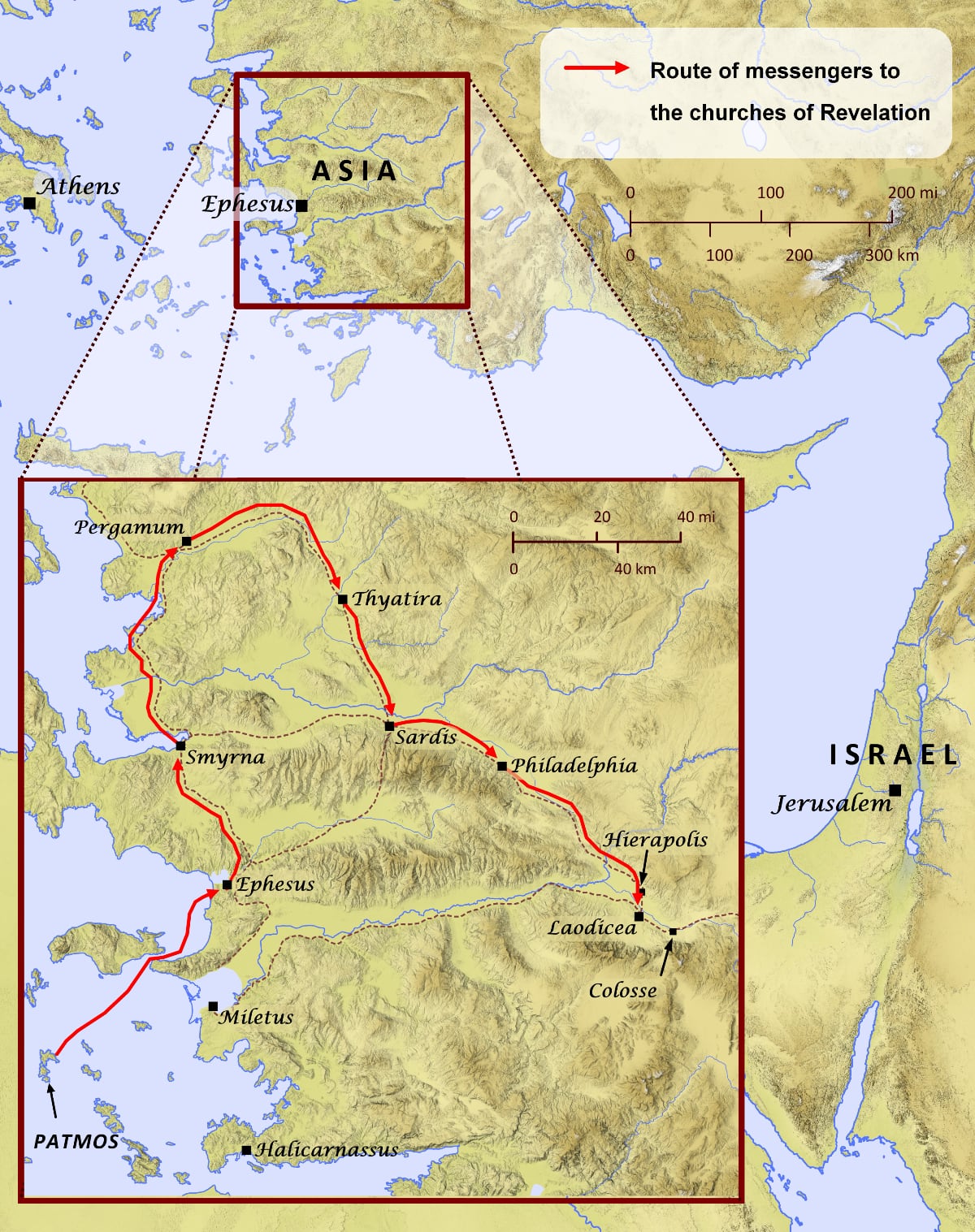
Image from https://biblemapper.com/
The KJV/TR opens the command with "I am Alpha and Omega, the first and the last: and," and addresses the churches "which are in Asia"; the critical text carries neither, reading ὃ βλέπεις γράψον εἰς βιβλίον καὶ πέμψον ταῖς ἑπτὰ ἐκκλησίαις — "What you see, write in a scroll and send to the seven churches." The opening clause is not a case of editions weighing manuscripts differently: the early Greek witnesses omit it without exception — Sinaiticus (01, c. 325–360), Alexandrinus (02), Ephraemi (04) — and the Byzantine Majority Text omits it as well. It is carried by the printed Received Text.
Re 2:1 — Ephesus
Re 2:8 — Smyrna
Re 2:12 — Pergamum
Re 2:18 — Thyatira
Re 3:1 — Sardis
Re 3:7 — Philadelphia
Re 3:14 — Laodicea
John Sees Glorified Jesus
The KJV/TR reads "seven lampstands" here; the critical text reads ἐν μέσῳ τῶν λυχνιῶν — "in the midst of the lampstands" — without the number.
Greek: ὅμοιον υἱὸν ἀνθρώπου. ὅμοιος ("like") ordinarily takes the dative — as it does elsewhere in Revelation — but here its object stands in the accusative in the NA28 and SBLGNT. The rendering is unaffected either way; the observation is recorded because the construction is irregular, not because the sense is in doubt.
Re 1:13, Re 14:14
Re 1:13, Re 15:6 — Soft link to priestly garments. Jesus is girded at the μαστοῖς "mastos," the upper chest, not the loins here. In 15:6, seven messengers have the same type of dress.
This is the only time wool is used and that is strictly related to the Lamb.
Does "white" apply to both head and hair? Yes, λευκαὶ applies to κεφαλή (head) + τρίχες (hairs)
Re 1:14, Daniel 7:9
"Fired" translates πυρόω (pyroō), the verb of πῦρ, fire: to put metal into the fire. English usually splits the word by the metal — bronze in a furnace is said to glow, gold in a fire is said to be refined — but the Greek says one thing in both places, and this edition keeps one word for it. The picture is not lost: the furnace stands in the verse, and what a furnace does to bronze is make it glow. The same fired word returns at 3:18, where the counsel to Laodicea is to buy gold fired by fire — gold that has been through the flame and come out proved. The glowing bronze of the vision and the proved gold of the counsel are the same word: metal in the fire, and shown true by it.
Re 1:15, Re 2:18, Re 10:1 — The Greek reinforces the shared fire imagery through the πυρ- word family. In Revelation 1:15, πεπυρωμένης comes from πυρόω, “to make fiery hot, burn, or refine,” a verb derived from πῦρ, “fire.” Revelation 2:18 repeats both the description of the feet as χαλκολίβανον (“burnished/fine bronze”) and the noun πῦρ in φλόγα πυρός (“a flame of fire”). Revelation 10:1 then describes the angel’s feet as στῦλοι πυρός (“pillars of fire”). Thus, the passages are linked by repeated fiery imagery and by the related Greek forms πυρόω–πῦρ–πυρός. The rare word χαλκολίβανον itself for brilliant bronze, however, does not contain the root πυρ-.
Re 1:15, Re 3:18
Re 1:16, Re 12:1 — This is like the woman with the 12 stars, but they are not the same. The 7 stars seem to represent Gentile church messengers or leaders, while the 12 stars in Revelation 12 appear to represent the heads of the tribes of Israel.
The KJV/TR reads λέγων μοι — "saying unto me"; the critical text reads λέγων — "saying" — without "unto me."
Re 1:17, Re 2:10
Re 1:5, Re 1:17, Re 2:8, 1 Corinthians 15:20-22, 1 Corinthians 15:45, Philippians 2:6-11 — This study takes a step of faith in siding with Codex Alexandrinus.
Given the context of Revelation and the pattern for identifying the Father at Revelation 22:13 and other passages, a drift toward “the first and the last” at 1:17 and 2:8 seems the more probable drift than a drift toward “firstborn.” Based on this study’s research, Alexandrinus shows greater overall accuracy than the other manuscripts, and that merit carries weight when judging “firstborn” the more likely reading. And having Jesus share a title with the Father, when Revelation keeps their identities distinct while still divine up to the disputed 22:13, makes Alexandrinus the less likely witness to have drifted from a theological standpoint. That drift toward converging the Father and the Son is not a guess — the tradition shows it happening. At 1:11 the Textus Receptus adds “I am Alpha and Omega, the first and the last” to the speaker’s words, an addition absent from the early codices and from the Majority Text alike — and the addition carries the very title in question. The sharing of the Father’s titles demonstrably grew over time, which makes the drift away from “firstborn” the more likely one. The context of both verses points the same way: at 1:17 and 2:8 the title stands beside Jesus becoming dead and living again — firstborn-of-the-dead territory — and Revelation has already named him “the firstborn of the dead” at 1:5. On that reading, “the firstborn and the last” may be pointing to 1 Corinthians 15 as the main connection here: the firstfruits of the dead and the last Adam. Paul already places both halves of the pairing on Jesus, so the phrase “firstborn and last” is not an awkward one.
Re 1:17, Re 2:8, Re 22:13 — At Revelation 1:17 and 2:8, NA28 prints “the First and the Last” (ὁ πρῶτος καὶ ὁ ἔσχατος), a reading directly preserved in Codices Sinaiticus and Ephraemi. Codex Alexandrinus instead reads “the Firstborn and the Last” (ὁ πρωτότοκος καὶ ὁ ἔσχατος); hence [Firstborn/First]. P98 is missing this portion, so we cannot decide between the readings. At 22:13, NA28 prints “the First and the Last,” as preserved in Sinaiticus, whereas Alexandrinus omits both articles and reads “First and Last”; hence [the] First and [the] Last.
The KJV/TR closes the declaration with "Amen"; the critical text lacks it here.
Re 1:18, Re 4:9, Re 4:10, Re 10:6, Re 15:7 — ζάω with αἰῶνας — lives ages to the ages. Only 1:18 refers to Jesus. The Father is never noted as being dead and then alive; only Jesus is described as being dead and then alive, whereas the Father is always living without death. In 1:18, Jesus is to be “alive unto the ages of the ages”. So while Jesus claims to live unto the ages of the ages, it is not the same structure or meaning as the connection of the same lemma he shares with the Father. Thus, when Revelation speaks of him "who lives unto the ages of the ages" (4:9), it is referring to the Father, not Jesus.
Re 1:18, Re 6:8, Re 20:13-14 — The Greek term here is ᾅδης, rendered "hell" in the KJV tradition. Revelation distinguishes Hell from the lake of fire: Death and Hell give up the dead, and then Death and Hell are cast into the lake of fire.
Present and Future
John is told to write, “the things which are, and the things which are about to come to pass after these things.” This points to chapters 2 and 3 as dealing with the present—the “things which are”—while also pointing forward to what is still to come. When we reach chapter 4, the focus shifts away from the things which are and moves exclusively to what will take place afterward: “things which must come to pass after these things” (Revelation 4:1). From chapter 4 forward, the vision is directed toward future events, unless the text itself says something is past or present, as it does at 17:10.
In light of Revelation 1:19, chapters 1–3 focus on what is present and what will follow. When the vision reaches Revelation 4, the emphasis shifts exclusively to “the things which must come to pass after these things.”
μέλλει - “is about to.” The verb says that a thing is set to happen, looming, whether near or distant. Its range runs from immediacy, “I am about to,” to certainty, “I will inevitably” (Wallace, Greek Grammar Beyond the Basics, 536), and the word itself does not say how soon. The same verb stands at 3:10, where the hour of testing “is about to come upon the whole inhabited-world”: a looming hour, not a counted one. At 4:1 the clause returns with the verb changed, ἃ δεῖ γενέσθαι μετὰ ταῦτα, “the things which must come to pass after these things.” δεῖ states necessity outright, and the shared wording lets 1:19 be read in that light: what is “about to” come after these things is what “must” come.
Re 1:1, Re 1:3, Re 1:19, Re 4:1, Re 22:6, Re 22:10 — The primary direction of the word of Revelation is toward the future. However, it is set in the context of the current time. Notably, the past is not the concern of the book of Revelation, so by default we do not expect to see anything here from John's time into the past. Revelation 4:1 sets that default for the events John is shown: “the things which must come to pass after these things.” Where the text itself says something is past or present, as with the seven kings, “the five have fallen, the one is” (17:10), the text has made the exception explicit. Without that time reference, any event could be placed in any time at will.
Seven Churches
Important Note: It is not a highly important theological detail in the study of Revelation, but it is worth noting that there is debate over whether the seven stars in Revelation 1 represent angels or the human leaders of the churches. Also, all the churches are told to "hear." We will see this again in Revelation 13:9, when the saints are given the choice to worship the beast or likely be killed. This kind of connection might lead one to think the church is destined for the tribulation. Yet the call to "hear" seems to be a link to obedience, not to identity — a call directed to a particular people, the saints, whether outside or inside the tribulation.
Bookends: There are bookends within the messages to the seven churches. The bookends are the opening and closing churches that need to return to God: Ephesus and Laodicea.
See the 12 stars in Chapter 12; these appear to point to the tribe heads of Israel in Chapter 12, while these 7 stars are connected to the messengers of the churches. If the church messengers are understood as human representatives, both star images would then involve human leaders within their respective groups.
The seven-and-twelve pattern also has support from the two feeding miracles. In the feeding of the five thousand, the setting is Jewish/Galilean and twelve baskets remain (Matthew 14:20; Mark 6:43; Luke 9:17; John 6:13), naturally fitting Israel's twelve tribes. In the feeding of the four thousand, the narrative follows Jesus' movement through Tyre, Sidon, and the Decapolis region, a Gentile or half-Gentile setting, and seven baskets remain (Matthew 15:29-39; Mark 7:31; 8:1-10). Jesus Himself keeps the twelve and seven basket counts distinct when He recalls both miracles (Matthew 16:9-10; Mark 8:19-20). This does not prove the Revelation imagery by itself, but it gives textual, historical, and geographical support for reading the seven stars as Gentile church messengers and the twelve stars as Israelite tribal heads.
“mystery” (μυστήριον) appears four times in Revelation and is applied specifically to the identity of two symbolic elements: the “seven stars” in Jesus’ right hand and “Mystery Babylon.” When we examine Mystery Babylon in its extended treatment (Revelation 17–19), she is set in deliberate contrast to the bride of Christ, the New Jerusalem. If the bride stands as the counterpart to this “mystery” city, and the seven stars are likewise called a “mystery,” the text may be suggesting a parallel in kind. In that case, the seven stars need not be understood strictly as heavenly angels, but could instead represent specific members within the body of the bride.
In the closing clause the KJV/TR repeats the relative clause — αἱ ἑπτὰ λυχνίαι ἃς εἶδες, "the seven lampstands which you saw"; the critical text reads αἱ λυχνίαι αἱ ἑπτὰ — "the seven lampstands" — without it.
Re 1:20, Re 10:7, Re 17:5, Re 17:7 — μυστήριον — Mystery is used four times. In Rev 1, the mystery concerns the seven stars and the seven lampstands, with the lampstands explicitly identified as the churches. In Rev 10, the "mystery of God" that is "finished" is unclear: whether the "mystery" refers broadly or specifically. When we look at the uses of mystery in Rev 17, both instances refer to Mystery Babylon. In 3/4 uses of "mystery," it is either tied to the churches or to Babylon. What is striking is that Mystery Babylon is directly contrasted with the image of New Jerusalem (17:3, 21:10). If there is meant to be a connection using the word μυστήριον, then it may be to reinforce the contrast of these two women. This may shed light on what Rev 10 describes as the mystery. The Mystery of God (that is, the one who is his) can be read as the church (Ephesians 3:4-6). If this relation is true for Rev 10, then μυστήριον refers twice to the church and twice to Babylon.
Linear Scene 1.1: Jesus sent His messenger to John to share the end-times signs, timeline, and church corrections and encouragements. This messenger appears to be a prophet based on Revelation 22:9, where he identifies himself as a fellow servant with John and with John's brethren the prophets. Jesus will speak to the seven churches, telling them all to overcome, and we will see that call for the church to overcome again at the end in Revelation 21:7. Chapters 1–3 are present and future in nature: they are addressed to real churches in John's day, while also aiming forward toward the things that “must come to pass shortly” and the “things which are about to come to pass after these things.” This is a core understanding that should frame our interpretation of the text. When the vision reaches Revelation 4, Jesus explicitly says, “I will show you the things which must come to pass after these things,” and this study reads the main prophetic details that follow under that forward-looking claim. The woman with 12 stars who gives birth, the fall of Mystery Babylon, and the arrival of the New Jerusalem out of heaven are future events within that framework.
Important Note: When Revelation speaks about overcoming, it connects back to John’s earlier writings. In 1 John 5:4-5, John explicitly links overcoming to one central truth: believing that Jesus is the Son of God. Revelation continues this same line of thought: the brethren overcome “because of the blood of the Lamb” (12:11), the same blood in which the multitude “have washed their robes” (7:14). This does not exhaust every way Revelation speaks of overcoming, since patience, testimony, and faithfulness are also part of the book's call. But from a salvation standpoint, no act is given greater weight than being found in Christ and washed in His blood.
Bookends: In the main story, we have the bookends of the blessings of “the words of the prophecy.” Yet greater, the one who is “the Alpha and the Omega” speaks, opening and closing the book.